

How to Protect Your Investment: A Guide to Travel Insurance
As more of you are planning trips further and further in advance, I wanted to talk about something that matters just as much as the destination itself: how you protect the investment you're making in that dream journey.
Travel insurance isn't the most exciting part of planning a trip. But the further out you plan, the more there is, in theory, that could change between now and departure, which makes understanding your coverage even more worthwhile.
Here's a closer look at what a typical policy covers, the add-ons worth knowing about, and a few details that catch even experienced travelers by surprise. Please keep in mind the coverage definitions may be different depending on the insurance underwriters. Coverage details can vary by provider and by state, so always read your specific policy closely or speak with a licensed insurance provider/your plan's customer service team. This article is for you to feel informed and make appropriate decisions. I'm happy to help you think through your options along the way.
What a Typical Policy Covers
Most comprehensive travel insurance plans are built around a handful of core protections:
Trip cancellation and interruption.
If you need to cancel your trip entirely, or cut it short once you've already left, for a covered reason such as illness, injury, or another specific event listed in your policy, this is what reimburses your prepaid, non-refundable costs.
Baggage loss, delay, or damage.
Coverage for the practical headaches of lost luggage, or the cost of replacing essentials if your bag doesn't arrive when you do.
Trip delay.
If a covered delay leaves you stranded and incurs an extra night in an airport hotel, meals you weren't planning to pay for, or ground transportation you didn't budget for, this benefit reimburses those costs. Verify the definition of “delay” – how long does it have to delay to be qualified for the insurance claim.
Emergency medical care and evacuation.
This is, in many ways, the most important piece, and the one most travelers underestimate. Medicare generally does not cover you outside the United States, and most domestic health insurance plans offer only limited coverage abroad, if any. Medical care in a foreign country can easily run $10,000–$50,000 or more for a serious emergency, and medical evacuation, if you need it, can cost even more. A strong policy typically includes at least $100,000 in emergency medical coverage and $250,000–$500,000 in evacuation coverage.
Add-Ons Worth Knowing About
Beyond the standard coverage, a few optional upgrades are worth understanding before you decide whether you need them:
Cancel For Any Reason (CFAR).
Standard trip cancellation coverage only pays out for specific, listed reasons. CFAR is the only way to cancel for something outside that list, including simply changing your mind, and it typically reimburses 50–75% of your insured trip cost. There are a few important catches: you generally must purchase it within 14–21 days of your first trip payment, you must insure 100% of your prepaid, non-refundable trip costs, and you must cancel at least 48 hours before departure. It also usually costs about 50% more than standard coverage. For a trip booked far in advance, where plans are more likely to shift, this is worth genuine consideration.
Pre-existing condition waivers.
Most policies exclude pre-existing medical conditions by default. A waiver can be added, but almost always within a similar tight window, typically 14–21 days of your first trip deposit. If this matters to you, it's not something to think about later. Be sure to verify the definition of “pre-existing” timing on your policy.
Specialty add-ons.
Depending on your itinerary, additional coverage may be worth considering for adventure activities, rental cars, or other specific circumstances not included in a standard policy.
What's Typically Not Covered
It's just as useful to know what a standard policy generally leaves out, not as a source of worry, but so your coverage actually matches your plans:
● Simply changing your mind about a trip. Standard cancellation coverage requires a specific, listed reason. If you want the flexibility to cancel for any reason at all, that's exactly what CFAR is designed for.
● Pre-existing medical conditions, unless you've added a waiver within the required window. Know the definition.
● Voluntarily extending your trip once you're already there, covered in more detail below.
This is something to remember when you make your decision, as they have a tight window to add to your policy.
Credit Card Travel Insurance: What It Generally Covers
Many travelers carry a credit card with travel benefits built in, and assume that coverage is enough on its own. It's worth understanding the real scope of what these cards typically offer.
Coverage is usually tied to the card itself.
Most credit card travel insurance only covers costs actually charged to that specific card. If part of your trip was paid another way, it may not be covered at all.
Domestic vs. international coverage can differ significantly.
Some cards provide meaningful protection for domestic travel but far less or none, once you leave the country. This is worth checking directly in your card's benefits guide, not assumed.
Medical coverage is the biggest gap.
This is worth verifying even for premium cards with substantial annual fees. Most credit cards offer little to no emergency medical benefit for international travel, and evacuation coverage, if included at all, is often minimal. Given that a serious medical emergency abroad can run into the tens of thousands of dollars, this is generally the single most important gap to fill with a standalone policy.
If you're relying primarily on card benefits, it's worth checking the details, including whether international trips are covered at all, whether there's any medical benefit included, and whether costs paid outside that card are protected too.
Three Details That Catch Travelers by Surprise
Beyond the headline coverage categories, a few finer points make a real difference when it actually matters:
Primary vs. Secondary Medical Coverage
This distinction sounds technical, but it has a very real impact on your experience if you ever need care abroad.
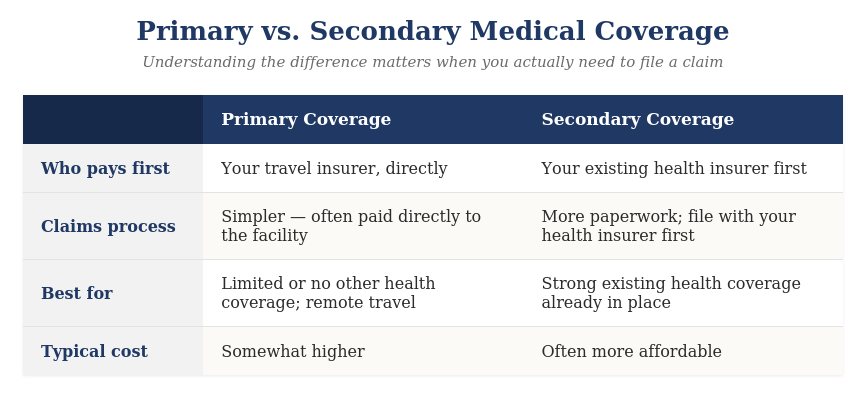
Primary coverage
means your travel insurance pays your medical bills directly, without requiring you to file a claim with your regular health insurance first. If you're at a clinic or hospital, this generally means a faster, more straightforward process, sometimes with the insurer paying the facility directly.
Secondary coverage
means your travel policy only reimburses you after your existing health insurance has paid what it will or declined the coverage. This can mean more paperwork, a longer wait for reimbursement, and, since many domestic health plans provide little or no coverage internationally to begin with, potentially a smaller payout overall.
If you already have strong, comprehensive health coverage, secondary travel insurance might be sufficient and more cost-effective. If your coverage is limited, or you're traveling somewhere remote, primary coverage is usually worth the difference.
Foreign Currency and Claims
If you need to file a claim while traveling, for a medical expense, a delayed flight, or lost baggage, those costs may be billed to you in a foreign currency. How your insurer converts that amount, and what exchange rate or date they use, can affect what you're actually reimbursed. It's a detail few travelers think to ask about in advance, but worth clarifying with your provider before you need to file a claim, not after.
Extending Your Trip Isn't Automatically Covered
This is one of the more commonly misunderstood aspects of travel insurance. If your return is delayed for a covered reason- a canceled flight, a medical emergency, severe weather- most policies will automatically extend your coverage until you're able to get home.
But if you simply decide, once you're there, that you'd like to stay longer because you fell in love with the destination, or a business trip runs long, that extension typically is not automatic. Voluntarily extending your trip generally requires either negotiating an extension with your existing provider (which may come with added fees or restrictions if they approve, but most providers do not). If there's any chance your trip could extend, it's worth planning for that possibility from the start before your departure.
Why This Matters More the Further Out You Plan
The broader travel industry is seeing a real shift: long-haul travelers are now booking trips 12, 15, even 18 months in advance, further out than ever before. That's a wonderful thing, which means securing the experiences that simply won't wait, and the properties, guides, and itineraries that matter most to you.
But it also means more time between booking and departure for circumstances to change. A longer runway is exactly why understanding your coverage, rather than treating it as an afterthought, matters more now than it used to.
The Right Policy Depends on the Trip
There's no single “best” travel insurance policy. The right choice depends entirely on where you're going, how long you'll be gone, what you've already paid for, and what kind of coverage you already carry through your health insurance or credit cards. A quick weekend getaway and a six-week international journey call for very different levels of protection.
One important note as you compare options: make sure you're comparing apples to apples. A lower-priced policy often means lower coverage limits, secondary rather than primary medical benefits, or fewer protections included. The fine print matters just as much as the price tag.

I'm always happy to talk through your trip and point you toward the right questions to ask and consider. It's a short conversation that can save a great deal of stress later and that's really the whole point of protecting the investment you've made in the journey ahead.
If you have a trip on the calendar and want to talk through your coverage options, I'd love to help. Just reach out anytime.