

Bhutan - Part II: In Search of the Secret Behind the Smile
Part II — Discovering the Heart of Bhutan
By the time we left Paro, I had begun to feel why Bhutan might feel different.
The mountains were spectacular, but mountains alone don't change people.
The luxury accommodations were exceptional, but beautiful hotels alone don't leave travelers with peaceful smiles.
I continued along on our journey with our team of a guide, supporting staff and a very skilled driver on the winding road. We drove through Punakha, Thimphu, and the remote Haa Valley. I noticed that there were many stray dogs sunbathing. They looked healthy and reasonably content. I asked our guide if they were approachable and if we could feed them. I assumed the answer was no because that’s how other countries are, but the guide encouraged feeding them. It turned out that the community people are taking care of them, so they are not hungry. They are very friendly and selective of what they eat in many cases. My Milk-Bone treats that happened to be in my pocket did not sit well with their taste. Well… as a dog person, it was kind of nice to see that they are healthy.
Punakha: Where Faith Lives in Everyday Life
Punakha is home to one of Bhutan's most important landmarks, the magnificent Punakha Dzong. Standing where two rivers meet, it is both a fortress and a monastery, serving as the winter residence of the Central Monastic Body.
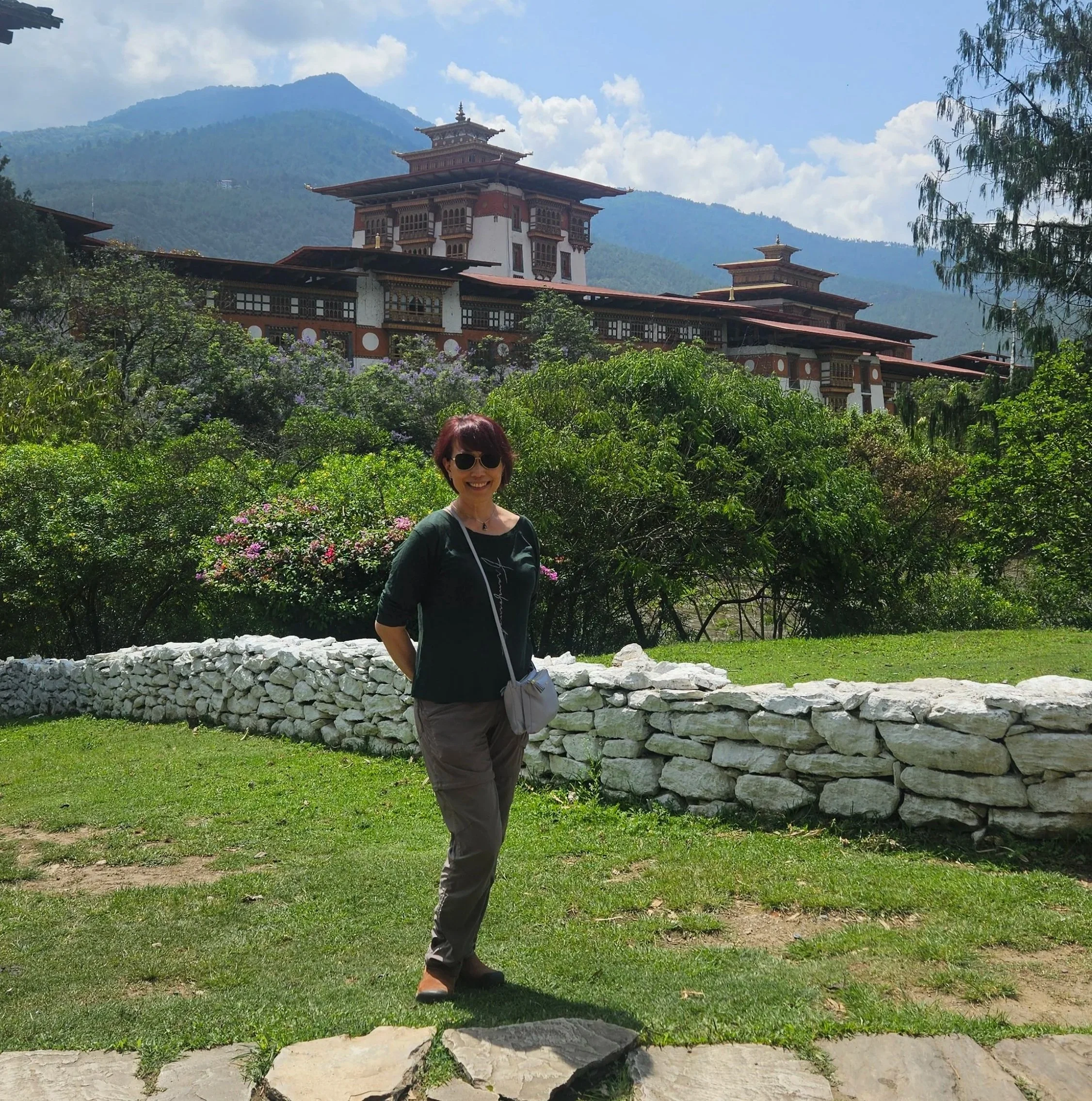
Punakha Dzong
Like many visitors, I admired its impressive architecture and intricate craftsmanship. Yet what fascinated me most was something I couldn't bring home in a photograph. Photography is not permitted inside the sacred temples. No shoes, no photograph.
Inside, colorful murals painted with natural pigments tell stories of the Buddha, protective deities, and Bhutanese history. Without a camera in my hands, I found myself slowing down and simply observing. Ironically, I probably remember those images more vividly because I wasn't trying to photograph them.
One of the privileges of this visit was spending time with the Chamberlain at the Punakha Dzong, a high-ranking senior monk.
Because my grandfather was a Buddhist monk and my mother grew up in a temple, speaking with monks has always felt familiar to me. Yet I was still struck by how approachable he was. Like the rest of us, he uses email and WhatsApp. Ancient wisdom and modern technology coexist quite naturally there.
During one of our conversations, he shared a thought that stayed with me throughout the journey: "Be mindful of the present moment. That is the only moment you can control." I imagine many of us have heard something similar before. I certainly had. What struck me in Bhutan was that it wasn't simply a philosophical quote. It was a way of life.
The more people I met in Bhutan, the more I realized this attitude wasn't unique to one monk. Variations of the same message would appear again and again throughout the trip.
Thimphu: A Modern Capital That Never Forgot Who It Is
Bhutan did not have TV until 1999. Travelers often imagine Bhutan as a country frozen in time, but Thimphu tells a different story.
As Bhutan's capital, it has modern apartment buildings, cafés, schools, and businesses. There are even familiar international brands. Yet despite these signs of modernization, I never felt that the city had lost its identity.
Traditional architecture remains protected. The royal residence “Dechencholing Palace” is located at the center of Thimphu city.
People proudly wear their national dress. The rhythm of daily life still feels uniquely Bhutanese. Rather than choosing between progress and tradition, Bhutan has found a way to balance them.
One of Thimphu's interesting landmarks is an intersection. Bhutan is one of the few countries in the world with no traffic lights. Instead, at the city's busiest intersection, a police officer stands in a colorfully decorated gazebo-like booth and directs traffic by hand. Locals call it the "dancing traffic light."
It can probably be replaced by a roundabout intersection, but it reflects something deeper about Bhutan. Even as the country continues to modernize, it chooses to preserve traditions and a human touch whenever possible. Watching the officer's almost choreographed movements, I couldn't help but smile. I also saw several officers in training for the position. I must be something they are proud to be hired for.
In Thimphu, we also gathered beside the river for a cooking class, learning to make Bhutan's beloved momo. I expected to learn a recipe, and I did, but in addition, I learned something about family tradition.
The chefs and staff didn't simply teach us how to fold dumplings. They shared stories of learning from their parents and grandparents. We laughed together, cooked together, and enjoyed lunch together. By the end of the afternoon, it felt less like an organized activity and more like spending time with friends.
Hospitality in Bhutan often feels this way.
It isn't performed. It's shared.
Later that evening we were invited inside the Great Buddha Dordenma for a private blessing ceremony.
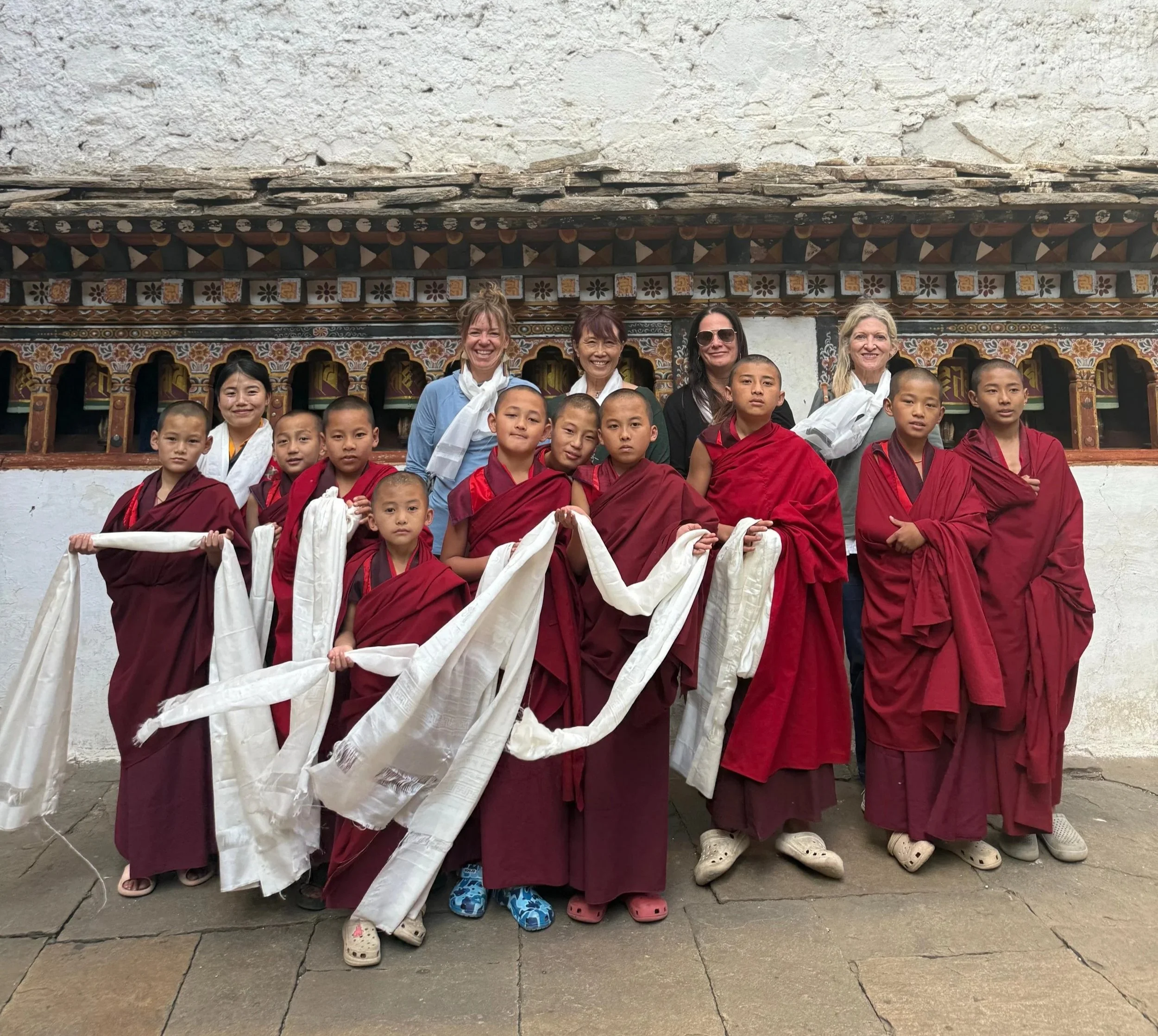
Receiving blessings for health, happiness, and safe travels was certainly memorable, but what remained with me was once again the conversation afterward. The head monk spoke with remarkable humility. He started with “Let’s have a casual conversation. Tell me, ‘How’s your life?’” Nothing casual about that question, but there was no attempt to persuade us or impress us with philosophy. Instead, he reminded us that happiness begins with taking responsibility for ourselves.
Live with kindness. Learn from your mistakes. Move forward.
I heard the same message here. Be mindful of the present moment.
Different place. Different teacher. The same quiet wisdom.
Luxury Through Bhutanese Eyes
Before coming to Bhutan, I wondered whether I would have to choose between authenticity and comfort.
I discovered that Bhutan offers both.
At Six Senses Thimphu, luxury felt almost invisible. The architecture reminded me of traditional Japanese design, warm wood, natural materials, clean lines, and breathtaking views over the valley. Every morning I found myself sitting quietly by the window, watching clouds drift across the mountains looking over the Great Buddha on the hilltop.
That became one of my favorite parts of the day.
Pemako Punakha created a bit of a different feeling.
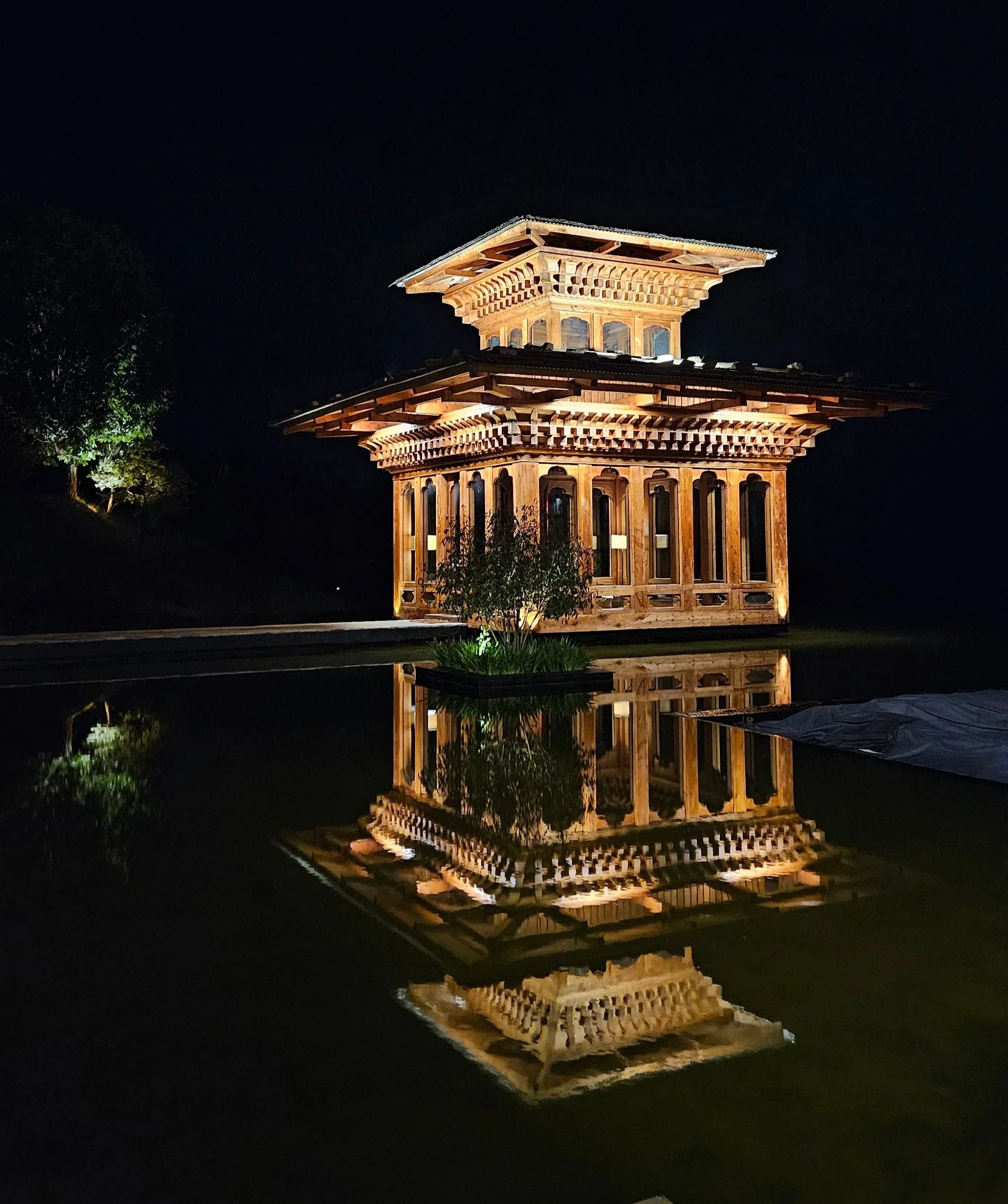
Pemako Thimphu
Upon arrival, we received blessings and a bracelet for happiness and repelling evil.
Inspired by traditional tented lodges, each spacious suite felt like a private sanctuary tucked into the hillside. A butler anticipated our needs, and after long days of exploring monasteries and mountain roads, returning to that peaceful space felt restorative rather than indulgent.
I also had the opportunity to visit &Beyond Punakha River Lodge. Beautifully positioned along the river and decorated with regional antiques, it reflected another side of Bhutanese luxury. The property encourages guests to step beyond the lodge and explore nearby villages on foot, reminding us that luxury here isn't about separating yourself from the destination.
It is about becoming part of it.
Although each property had its own personality, they all shared something important: Luxury wasn't trying to compete to be better. It’s simply the space to appreciate it.
Haa Valley: The Lesson I Didn't Expect
If I had to choose one experience that best reflected everyday Bhutan, it would be our visit to the Haa Valley.
Remote and peaceful, the valley offered some of the most authentic moments of the journey.
We stayed at a remarkable seasonal glamping camp that blended comfort with nature. We were welcomed by a team of staff who worked on building the site with warm water, our camp with WIFI, a warm bed, and a sitting area with a toilet and a warm water shower. We also enjoyed a performance by a choir singing their traditional song beautifully harmonized. They are all temporary settings uniquely designed by our partner company; they will be removed after the guests move on to the next site. We also enjoyed the hot stone hot tub and walked into the cold water river and back to the hot spring. The hot stones are heated in red. They dump them into a bucket of water to cool it some before putting them in a small section of the tub. They warm up the water as if the hot water were coming out of a faucet.
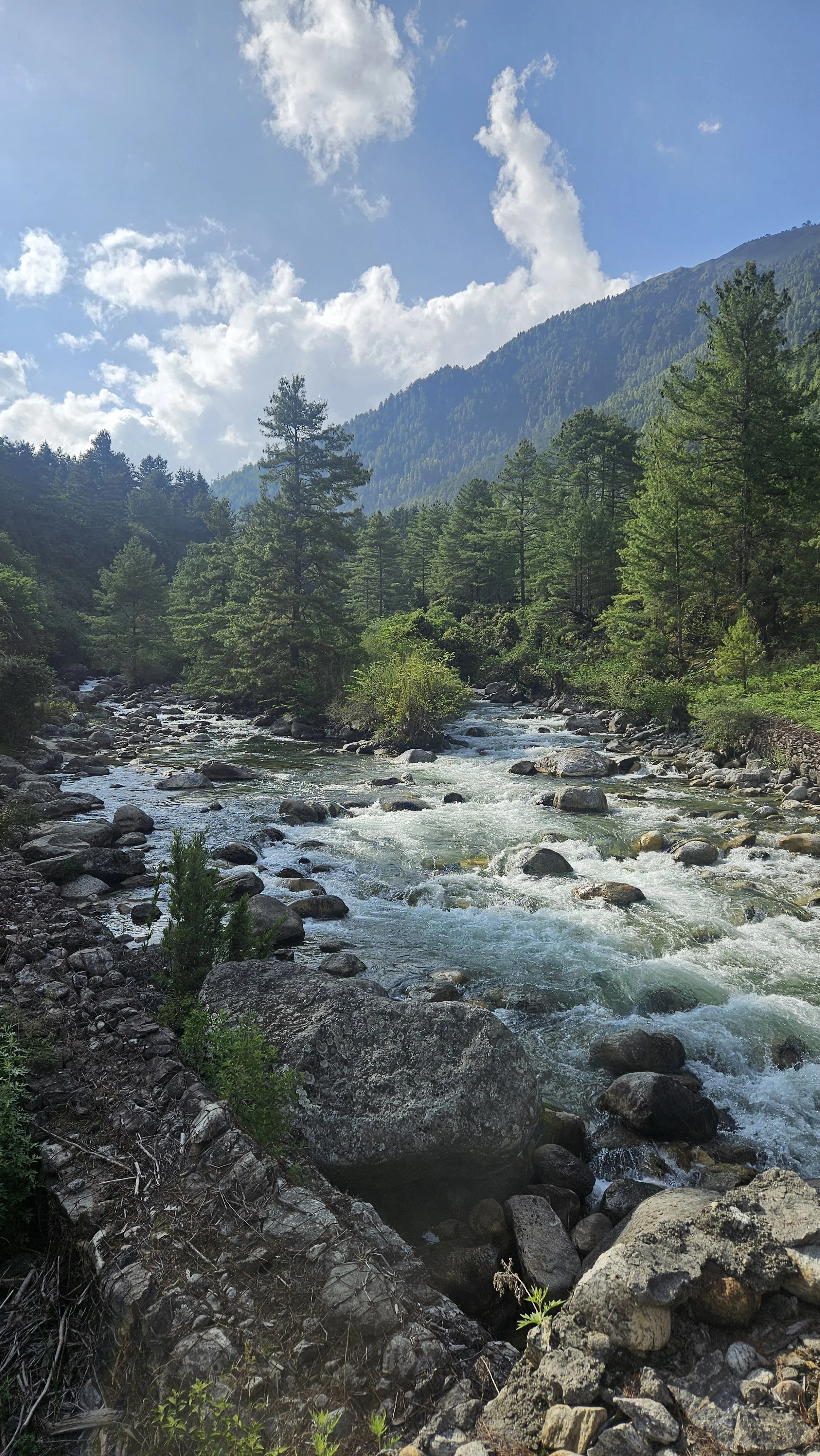
View from our glamping site in Haa Valley
Before arriving at the camp, our partner team prepared a surprise for us!
We were invited into the home of a farming family for lunch. There was no performance. No rehearsed presentation. Just genuine hospitality.
We removed our shoes, sat together on comfortable floor cushions, and shared a home-cooked meal. We used forks and spoons while our hosts comfortably ate with their hands. No one seemed self-conscious about the differences. We were simply sharing a meal.
Afterward, they welcomed us into their family shrine. Standing inside their home, I learned something that perfectly illustrated Bhutan's values. Many families invest in beautiful spaces for prayer and reflection before spending money on conveniences we might consider more important, such as an indoor bathroom or kitchen.
Their priorities are different.
Not better. Not worse. Simply different.
Driving through the surrounding rice fields later that afternoon, we visited their family, who rescue red pandas in the area. There was one under their care who lost his mother in an accident. He was shy but took a piece of apple from our hands. I began thinking less about what Bhutan looked like and more about how Bhutanese are.
The people I met weren't chasing a different life. They were nurturing the one they already had.
As we left the Haa Valley, only one destination remained.
Tiger's Nest in Paro.
Like every traveler before me, I expected it to be the highlight of the journey.
I wasn't wrong. But not for the reason I expected.
Next: Tiger's Nest and the Answer I Came Looking For.